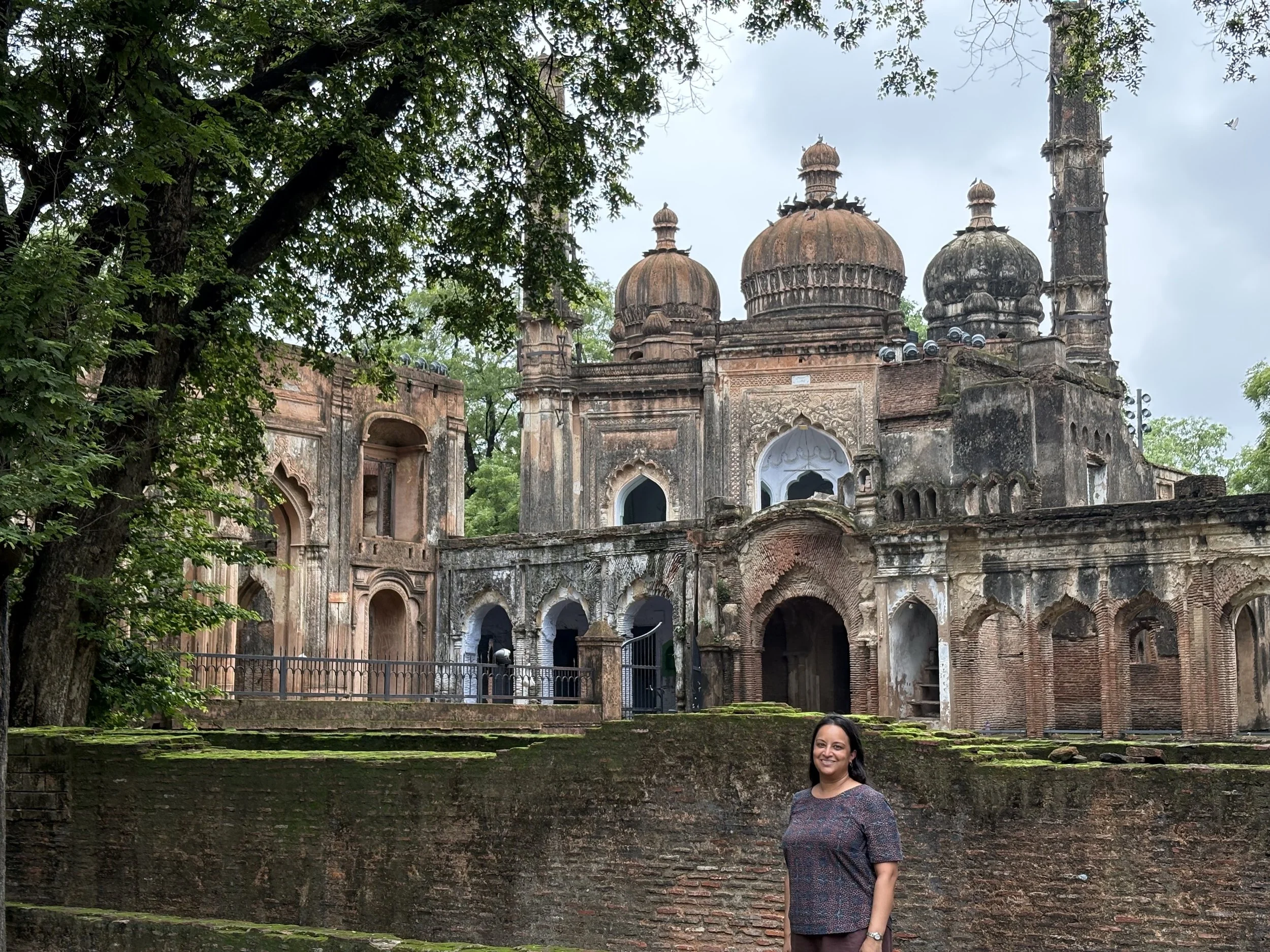
I am an Assistant Professor of English at the United States Naval Academy where I specialize in representations of nationalism and cultural belonging in colonial-era and modern Indian literature. My broader research and teaching interests include postcolonial literature and theory, theory of the novel, and British imperial philosophies and literatures of empire. My articles and reviews have been published or are forthcoming in LIT: Literature Interpretation Theory, Verge: Studies in Global Asias, Interventions: International Journal of Postcolonial Studies, The Journal of Commonwealth and Postcolonial Studies, and South Asia: Journal of South Asian Studies. Before coming to USNA, I was an Assistant Professor in the Department of English at the University of Mississippi. I received my graduate training at the University of Pennsylvania (Ph.D. in English, 2016) and the University of Michigan (M.A. degrees in English and South Asian Studies, 2009).
My first book, Imagining Bharat: Colonialism, Nationalism, and the Politics of Form in the Indian Novel, 1880- 1920, is under contract with the University of Virginia Press (Cultural Frames, Framing Cultures Series) and due to be published in 2028. Bringing together a range of turn-of-the-century Indian novels published in Bengali and English, the book illuminates how these texts mythologized India as a primordial Hindu homeland amidst evolving anticolonial and nationalist thought at the turn of the twentieth century. As these authors balanced a number of seemingly incompatible aims in their fictions (i.e., imagining India as a Hindu homeland while expressing faith in British colonialism), they produced highly heterogeneous works that were often at once historical romances, epics, myths, and political tracts. Contravening long-standing appraisals of these novels as inferior, puzzling, and aesthetically unsatisfactory, I argue that their formal experimentations and innovations constitute sophisticated engagements with genre. In its revelation of many turn-of-the-century Indian novels’ engagement with a kind of moral realism that urged inclusion and belonging along various lines, Imagining Bharat demonstrates that visions of Indian national belonging were not always as exclusionary or violent as those that now dominate the country. In line with recent developments in Victorian studies—a field that has become especially attuned to the insights of postcolonial theory over the past several years—this book illuminates hitherto shadowy pathways and manifestations of the novel form that powerfully disrupt received understandings of the genre and the place of seemingly peripheral, non-Western narratives therein. My second book project on select fictions by authors including Benjamin Disraeli, G.W.M. Reynolds, and O. Chandumenon is poised to further contribute to global Victorian studies and Indian literary studies by exploring issues of adaptation, appropriation, and influence.
Quisque iaculis facilisis lacinia. Mauris euismod pellentesque tellus sit amet mollis.